

CRM governance: who is actually governing the CRM work?
When CRM is in place, but still lacks clear ownership, prioritisation and follow-up
Many organisations have a CRM system in use, campaigns running and automations in place. Even so, it is often unclear who is governing the direction, how changes are prioritised, and who follows up whether the work is actually creating impact. The problem is rarely only the system. It is that the CRM work lacks clear governance.
CRM rarely loses impact because the platform is weak. It loses impact because governance is unclear.
Why CRM is often used, but weakly governed
In many organisations, CRM is already an active part of everyday work. Campaigns are sent out, automations are adjusted, customer data is updated, and new needs are continuously entered into the system. It can therefore look as if the CRM work is well established and in motion.
Even so, there is often a clear gap between activity and actual governance. Many people work in CRM, but fewer govern how the work should hang together over time. Changes happen, but without a clear logic for what should be prioritised first, who decides what, and how the impact should be followed up.
That is also why CRM so easily gets reduced to a production system for campaigns, journeys and updates. When no one owns the whole, the work is often driven by ongoing needs, individual initiatives and short-term requests, rather than by a coherent direction for how CRM should support the customer journey and the organisation’s goals.
In other words, the problem is rarely that CRM is not being used. The problem is that it is used by many, while the governance of the work remains unclear.
CRM work can be active every day and still lack clear governance.
When CRM lacks governance
Many CRM environments look well functioning on the surface. The system is in use, activity levels are high, and updates happen continuously. Even so, weak governance often becomes visible in how the work is actually organised, prioritised and followed up over time.
This is often where the difference becomes clear between CRM work that is simply kept running and CRM work that is actually governed.
No one owns the whole
Many people work in CRM, but few are responsible for bringing together direction, prioritisation and follow-up. The result is often that the whole becomes weaker than the sum of the activities.
Changes happen without governance
New requests, fields, journeys and initiatives are added continuously without a clear assessment of coherence, consequences or what should be prioritised first.
CRM becomes a production system
The work easily revolves around sends, updates and deliveries, rather than around how CRM should support the customer journey and the organisation’s goals over time.
Follow-up stops after launch
Initiatives are started continuously, but few people follow up systematically on what is actually working, what should be adjusted, and which changes are creating real impact.
Weak governance does not necessarily make CRM less active. It makes it less directed.
CRM governance is not about control for its own sake
When governance is weakly defined, it also becomes easy to misunderstand what it is actually meant to contribute. For some, it may sound like more control, more rules or more bureaucracy. In practice, however, CRM governance is much more about creating clarity in how the work is governed, prioritised and followed up over time.
The key is not to control more of everything. It is to make sure the CRM work actually hangs together, that changes are assessed in a broader context, and that someone is responsible for direction and follow-up.
When CRM is weakly governed
- prioritisation happens ad hoc
- changes are driven by individual needs
- responsibility is distributed unclearly
- follow-up becomes inconsistent
- the work is driven more by activity than by direction
- CRM is used, but developed weakly over time
When governance is clear
- prioritisation is assessed as a whole
- changes are seen in context
- responsibility is clearly defined
- follow-up is used for improvement
- the work is guided towards clearer goals
- CRM is developed more deliberately over time
The difference is not about how much activity exists in the CRM environment, but about how well the organisation governs what is happening. When governance is clear, CRM is not just something that is kept running. It becomes a more coherent and manageable part of the customer work.
Good governance does not make CRM heavier to run. It makes it easier to govern.
CRM rarely loses impact because the platform is weak
CRM rarely fails because features are missing. More often, it fails because the governance around them is too weak.
The system may be full of features, integrations and activity, and still create less value than expected. When governance, ownership and prioritisation are unclear, the problem rarely lies in what the platform can do. It lies in how the organisation structures the work around it.
What good CRM governance must actually include
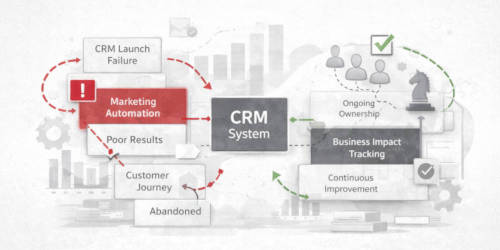
If CRM is to function as more than a production system for campaigns, updates and journeys, governance must be clearer than only at an overall level. It is not enough that many people use the system actively. Someone must also own how the work is governed, assessed and improved over time.
In practice, this often comes down to four areas that must be clearly defined if the CRM work is to gain direction and impact.

Ownership
Someone must be responsible for the whole CRM effort and govern it over time. Without clear ownership, many influence the work, but few actually govern its direction.

Prioritisation
Requests, changes and initiatives must be assessed against one another. Otherwise, CRM is driven by ongoing needs instead of clearer goals and priorities.

Decisions and changes
It must be clear who decides what should be adjusted, stopped or developed further. Without that structure, CRM becomes fragmented and harder to govern.

Follow-up and improvement
Impact must be followed up over time, and learning must be carried forward into the work. Otherwise, CRM stays active, but weaker as a governed area.
Governance only becomes clear when ownership, prioritisation, decisions and follow-up work together.
What characterises organisations with clear CRM governance
Organisations that create more value from their CRM work rarely stand out because they have the most features or the most advanced platform. More often, the difference lies in how the work is governed over time. They do not use CRM as an isolated campaign or production track, but as part of how customer work, prioritisation and improvement are connected.
That also means they are clearer about who owns the whole, how new needs are assessed, and what should actually be given priority. They also tend to show stronger discipline in how changes are decided and how impact is followed up after something has been launched.
In practice, this often comes down to four clear differences:
CRM has clearer ownership across activities
Changes are assessed in context, not one by one
Priorities are guided more by goals than by individual needs
Follow-up is used actively for learning and improvement
When these elements are in place, CRM becomes easier to govern as one coherent area of work. That is often where the difference appears between organisations that merely keep CRM running and organisations that actually use it to support a clearer customer strategy.
CRM only creates value when it is governed as a work area
CRM can be full of activity, features and initiatives, and still create less value than expected. Only when the work has clear ownership, stronger prioritisation and better follow-up over time does CRM begin to function as more than a system in operation.
That is why the question is not only whether the organisation has chosen the right platform or set up the right journeys. The decisive factor is whether the CRM work is actually governed in a way that makes it possible to prioritise more intelligently, develop the whole and follow up what is working.
When CRM is active, but still lacks clear direction on what should be followed up first, it can be useful to start with an initial assessment of the current situation. That makes it easier to see where governance is weakest, where coherence breaks down, and where further follow-up should begin.
If you want an initial indication of how CRM and customer journeys are functioning in practice in your organisation, it may be useful to start with an initial assessment of the current situation. Read more about GTI Journey Diagnostic or book a no-obligation conversation with us if you would like to discuss the situation before moving forward. You can also explore more articles in our Insights section.


Ready for a first assessment?
See how well your customer journeys actually work together in practice
Many companies have activities, systems and initiatives in place, but still lack a clear view of how their customer journeys work as a whole. Journey Diagnostic gives you a free first assessment of current status and possible gaps.