

CRM is not a system – it is an operating model
Why CRM only creates impact when insight, follow-up and prioritisation work together in practice
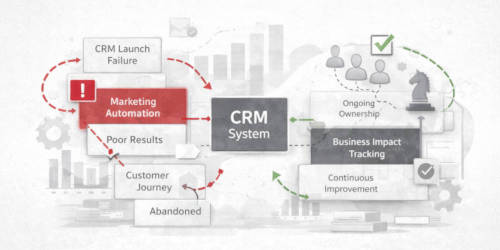
CRM is often treated as a system decision or an implementation project. In practice, the real effect only appears when CRM functions as an operating model for how the business follows up customers, uses insight and prioritises what happens next.
CRM does not create impact on its own. The way the organisation works does.
Why CRM so often gets reduced to system choice and functionality
CRM is often discussed in language centred on platforms, features and implementation. The questions usually revolve around which system the business should use, which dashboards should be set up, and which automations can be built. That is understandable, but it also means CRM is easily treated as a technology decision rather than an operating model.
CRM as a system
- focus on platform and features
- implementation and setup
- fields, dashboards and automation
- project logic rather than ongoing use
CRM as an operating model
- focus on follow-up and prioritisation
- use of insight in practice
- coordination across teams and customer journeys
- continuous improvement over time
When CRM is understood too narrowly, it is evaluated based on what the system can do rather than how the organisation actually works with customers, insight and follow-up. That is often where the impact starts to slip.
What it means to work with CRM as an operating model
Working with CRM as an operating model means CRM is not only used to store data or send communications. It becomes a structure for how the business follows up customers, uses insight, prioritises customer journeys and improves the work over time.
CRM then becomes part of how the organisation actually operates in practice, rather than just a system that has been implemented and made available.
Clear ownership
Someone must be responsible for how CRM is used and developed in practice.
Use of insight in practice
Data and observations must be used actively in prioritisation and follow-up.
Prioritised journeys
CRM must support the customer journeys that matter most to the business.
Continuous improvement
The work must be adjusted and developed over time, not stop at setup and launch.
When these elements are in place, CRM becomes something the business works with, not just something it has. That is also when the system starts to create real value.
Common signs that CRM is only being treated as a system
It is not always obvious when CRM is being used too narrowly. It often shows up as small but clear signs that the system is in place, while the way of working around it is still unclear. CRM then becomes something the business has invested in, but not something it fully works by in practice.
Data exists, but is used very little
Information is collected, but only used to a limited extent for prioritisation and follow-up.
Automation runs without clear direction
Journeys and messages exist, but are only weakly connected to goals, customer needs and learning.
Ownership is fragmented
Several teams use CRM, but no one owns the full picture of how it is supposed to work.
The system supports, but does not guide
CRM is used as a tool, but it is not clearly integrated into how the business works going forward.
When several of these signs are present at the same time, CRM is often implemented as a system, but not established as an operating model. That is also when the impact becomes more limited than the business expected.
What characterises organisations that work well with CRM
Organisations that get real value from CRM do not use it only as a platform or a channel. They use it as part of how they follow up customers, prioritise effort and improve the work over time. CRM then becomes an integrated part of operations, rather than just a system in the background.

CRM is used to guide priorities
Insight and data are not only used for reporting, but to assess what should be followed up, adjusted and developed further.

Priority customer journeys are clear
The business knows which customer journeys CRM is meant to support, and what matters most to improve within them.

Responsibility and ownership are defined
It is clear who follows up how CRM is used, developed and embedded in practice.

Improvement happens continuously
CRM does not remain a finished setup, but is adjusted in line with needs, experience and results.
This is often the difference between CRM becoming a system the business has and an operating model it actually works by.
Why this is demanding in practice
CRM as an operating model often sounds simpler than it is. In practice, CRM touches several functions at the same time, and the value depends on insight, follow-up, prioritisation and customer journeys working together over time. That is why responsibility easily becomes fragmented, and CRM gets reduced to system administration rather than an actual way of working.
CRM rarely fails because the system lacks features. It fails because the operating model is unclear.
Marketing, sales, customer service, product and operations may all depend on CRM, but often with different goals, KPIs and ways of working. That means it is not always clear who should own the whole, what CRM is actually meant to be used for, or how improvements should be prioritised going forward.
At the same time, it is easier to buy, implement and configure a system than to establish a shared way of working. That is also why it is common for CRM to be technically in place while the operating model around it remains unclear.
That is why it is not enough for CRM simply to be in place. The business must also have a clear way of using CRM in practice.
When it makes sense to start with an initial assessment
When CRM is in place but the impact remains unclear, it can be useful to start with an initial assessment of the current situation. That makes it easier to see where CRM actually supports the work, where the gaps are, and what may need to be prioritised next.
When CRM is used differently across teams
It is unclear how CRM is actually meant to support marketing, sales, service and follow-up as a whole.
When the impact is unclear
The system is in use, but it is difficult to see what is actually creating impact, where it happens and why.
When governance is unclear
CRM exists as a platform in the business, but not as a clear model for prioritisation and further development.
GTI Journey Diagnostic is designed for exactly these types of situations. The service provides an initial indication of current status, coherence and possible gaps in how CRM, customer journeys and follow-up appear to work in practice.
Read more about GTI Journey Diagnostic and how the service can be used as a practical first step.
Conclusion
CRM does not create value simply because the system is in place. The value only appears when CRM functions as an operating model for how the business follows up customers, uses insight and prioritises further work in practice.
When CRM is reduced to platform, features and setup, the impact also tends to become more limited than expected. If you want an initial indication of how CRM, customer journeys and follow-up actually fit together in your own organisation, you can read more about GTI Journey Diagnostic or start directly with a free assessment.
You are also welcome to book a no-obligation conversation with us if you would like to discuss your situation before moving forward, or explore more articles in our Insights section.

Ready for a first assessment?
See how well your customer journeys actually work together in practice
Many companies have activities, systems and initiatives in place, but still lack a clear view of how their customer journeys work as a whole. Journey Diagnostic gives you a free first assessment of current status and possible gaps.