
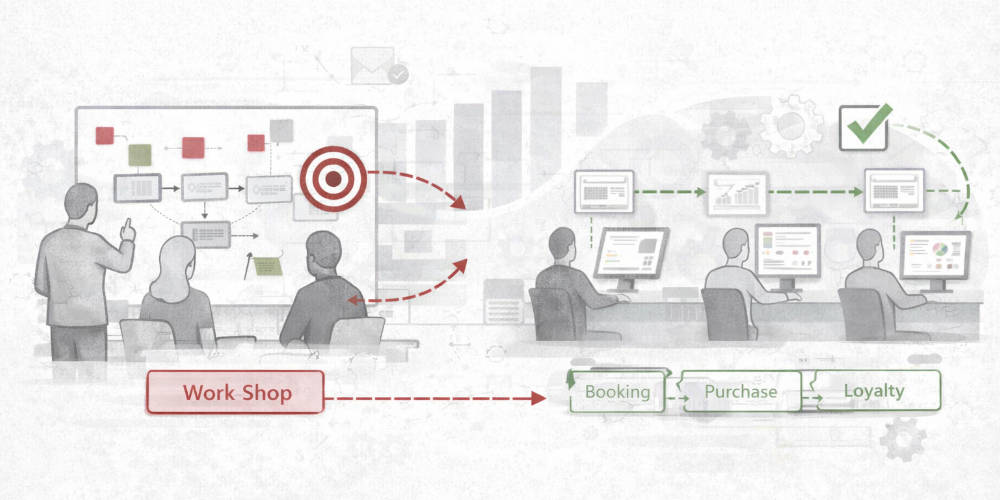
Customer journeys are not a workshop. They are a way of working
And that is why most customer journeys in practice stop before they create real impact.
Many organizations spend time and resources mapping customer journeys. Flowcharts are drawn, workshops are held, and good descriptions are created of how the experience should work. Even so, very little often happens in practice afterward and the customer journey management stop.
Not because the thinking is wrong, but because customer journeys are treated as a project rather than as an ongoing way of working.
Customer journeys rarely fail because of lack of insight
In most organizations, there is already a great deal of insight into the customer journey. They often know who their customers are, which touchpoints matter most, and where friction occurs. Even so, that insight is rarely turned into lasting improvement.
What many organizations already know
- who their customers are
- which touchpoints matter most
- where friction and uncertainty arise
What is often still missing
- tclear ownership of follow-up
- prioritization of what actually needs to be improved
- a structure for adjusting and following up over time
The problem is rarely what has been mapped. More often, it is what happens afterward. Insight without ownership and follow-up becomes documentation, not improvement.
When customer journeys become a one-off initiative
A common pattern is that customer journeys are treated as a limited activity rather than as part of ongoing operations.

Workshop
the journey is mapped in a limited setting, often disconnected from day-to-day operations

Project
the work has a clear beginning and end, but no lasting ownership afterward

Documentation
focus moves on, and the customer journey is left behind as a file rather than used as a management tool
That is when progress often stops. The insight is not used further, new needs are not picked up, and the customer dialogue gradually loses relevance.
Customer journeys need to be embedded in real operations
Customer journeys that create lasting impact over time tend to share a few clear characteristics. They are not only well mapped, but embedded in how the business actually works in practice.
they are closely connected to day-to-day operations
they are owned by clearly defined roles and responsibilities
they are continuously adjusted based on real insight and changes over time
The difference between mature and immature customer journeys often lies in the transition from analysis to action.
From mapping to operational flow
The difference between mapping and real impact rarely comes down to how much has been documented. It comes down to what actually needs to be in place for the customer journey to work operationally in practice.
Immature organizations
- visualize, but use it very little in operations
- rely on assumptions than actual behavior
- lack a structure for further development
Transformation factors
- clear ownership
- connection to goals and priorities
- ongoing operational follow-up
Mature organizations
- use journeys actively in prioritization
- connect journeys to goals and outcomes
- adjust content, timing, and channel use
What matters is rarely how much has been mapped, but how much of it is actually used to guide everyday decisions.
Customer journeys as a discipline, not documentation
Customer journeys only create impact when they are treated as an ongoing discipline, not as a finished map.
This typically involves four short principles:
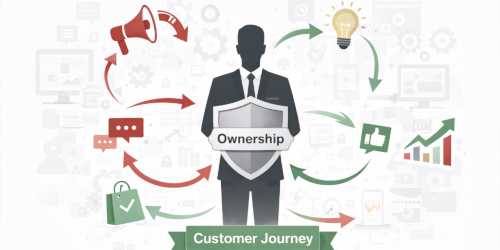
Clear ownership
someone must be responsible for following up and driving the work forward
A fixed rhythm
evaluation and adjustment happen regularly, not only when needed
Data-driven adjustment
changes are guided by actual customer behavior and usage
Connection to systems
the journey must be integrated into CRM and everyday workflows
That is when the customer journey becomes a tool for improvement rather than just an illustration of intent.
From mapping to actual improvement
Strong customer journey management is rarely created through workshops and documentation alone. They are created when insight is used to prioritize, adjust, and improve the customer experience as part of day-to-day operations.
When customer journeys in practice are anchored in clear roles, real signals, and ongoing follow-up, they become more than a description of intent. They become a management tool for improvement over time.
If you want an initial indication of how customer journeys, follow-up, and improvement work together in your business, you can read more about the GTI Journey Diagnostic or go straight to the free assessment. You can also book a no-obligation conversation with us if you would like to discuss your situation before taking the next step, or explore more articles in our Insights section.


Ready for an initial assessment?
See where the customer journey breaks down between insight, follow-up, and actual improvement.
The GTI Journey Diagnostic provides an initial indication of where gaps arise between observation, prioritization, and action. It makes it easier to see what should be improved first.