

When CRM doesn’t deliver results, the problem is rarely the technology
The challenge often lies in how the work is organized after launch
Many CRM initiatives begin with a strong focus on technology. Which platform should we choose? Which integrations are required? Which features do we need? However, when CRM doesn’t deliver the expected results, the problem is rarely the technology itself.
Experience from many organizations shows that the real challenge often lies in how CRM work is organized and followed up after launch.
Why CRM projects often start in the wrong place
Many CRM initiatives begin with good intentions. The goal is better customer experience, more relevant communication, and stronger loyalty over time.
Even so, many projects begin at the wrong end. The discussion often starts with technology rather than governance, ownership, and ongoing development.
The questions that often dominate the CRM discussion
Which CRM system should we choose?
Which integrations need to be in place?
Which features do we need?
These are, of course, important questions. The problem arises when technology becomes the main focus, while the work around CRM, organization, ownership, and further development receives less attention. When this path is followed we often see that CRM doesn’t deliver results as expected.
The result is often that a great deal of energy goes into implementation and launch, while the work that comes afterward is much less clearly defined.
CRM then becomes a project to deliver, rather than a capability to develop over time.
What often happens after launch
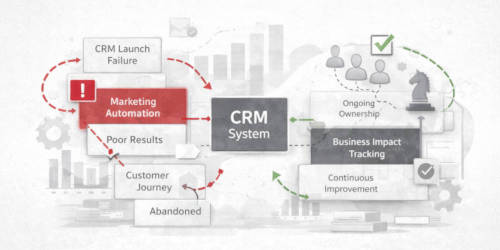
Once a CRM system has been implemented and launched, many businesses find that the work gradually loses momentum and that CRM does not deliver the expected impact.
The project has been delivered, the system is in place, and the key integrations are working. Attention then shifts to new initiatives, while CRM becomes less and less of a tool used to guide day-to-day operations.
Without clear ownership and structure, several things tend to happen
Campaigns
Campaigns and initiatives are carried out more sporadically
Customer journey improvements
Work on improving customer journeys receives lower priority
Data and insights
Data and insights are used only to a limited extent to adjust activities
Further development
Responsibility for CRM development becomes unclear across the organization
The result is that the system works technically, but the expected impact does not materialize. In practice, CRM becomes a tool for sendouts and reporting rather than a management tool for developing customer journeys and customer experience.
What must be in place to create results
For CRM to contribute to better customer experiences and increased business value, the work must be organized as a continuous development process — not as a one-time project.
This means that CRM must have a clear place in the organization, defined ownership, and a structure for how customer journeys are analyzed, improved, and developed over time.
Experience from many organizations shows that three factors are critical
Clear ownership
CRM work must have a clear owner within the organization. This role should be responsible for prioritizing, coordinating, and developing customer journey initiatives over time.
Structured work
CRM creates results when work on customer journeys happens systematically over time. Initiatives should be planned, prioritized, and followed up as part of a structured development process.
Continuous improvement
Insights from CRM should be actively used to analyze results and improve customer journeys.These insights should guide testing, adjustments, and ongoing improvements over time.
When ownership, structure, and continuous improvement are in place, CRM can evolve into a long-term effort focused on analyzing, prioritizing, and improving customer journeys.
How to organize CRM work in practice
For CRM to function as a continuous effort, the work must be organized in a way that supports this in practice.
In many organizations, CRM work is spread across several functions. Marketing runs campaigns, sales follows up customers, and IT is responsible for the systems. At the same time, customer journeys are influenced by decisions in product, service development, and customer support.
To create real impact, these perspectives need to be brought together.
This often means organizing CRM as cross-functional work, where different roles collaborate to analyze customer journeys, prioritize improvements, and develop initiatives over time.
Across many CRM initiatives, a recurring pattern emerges: organizations that create lasting results tend to structure the work around a simple cycle of analysis, prioritization, and improvement.
A simple working model consists of three steps

Analysis
Data from CRM and other sources is used to understand how customers move through the journey and where friction occurs.

Prioritization
Based on these insights, initiatives are prioritized that can improve customer experience or strengthen business results.

Improvement
Initiatives are tested, adjusted, and developed further as part of a continuous learning process.
When CRM is organized as a continuous effort focused on analysis, prioritization, and improvement, the system can evolve from a reporting tool into a strategic management tool for customer journeys.
From system to management tool
CRM rarely creates impact simply because the technology is in place. The real effect comes when the work around the system is organized as a continuous process for analysis, prioritization, and improvement of customer journeys.
CRM only creates impact when the work around the system is organized as a continuous development process.
CRM does not deliver impact when it is reduced to a platform, a set of features, and a technical setup. In those cases, the effect is usually more limited than expected. If you want an initial indication of how CRM, customer journeys, and follow-up actually work together in your own business, you can read more about the GTI Journey Diagnostic or go straight to the free assessment.
You can also book a no-obligation conversation with us if you would like to discuss the situation before taking the next step, or explore more articles in our Insights section.


Ready for a first assessment?
See where CRM work breaks down between insight, follow-up, and actual improvement
The GTI Journey Diagnostic provides an initial indication of where gaps arise between observation, prioritization, and action. It makes it easier to see what should be improved first.