
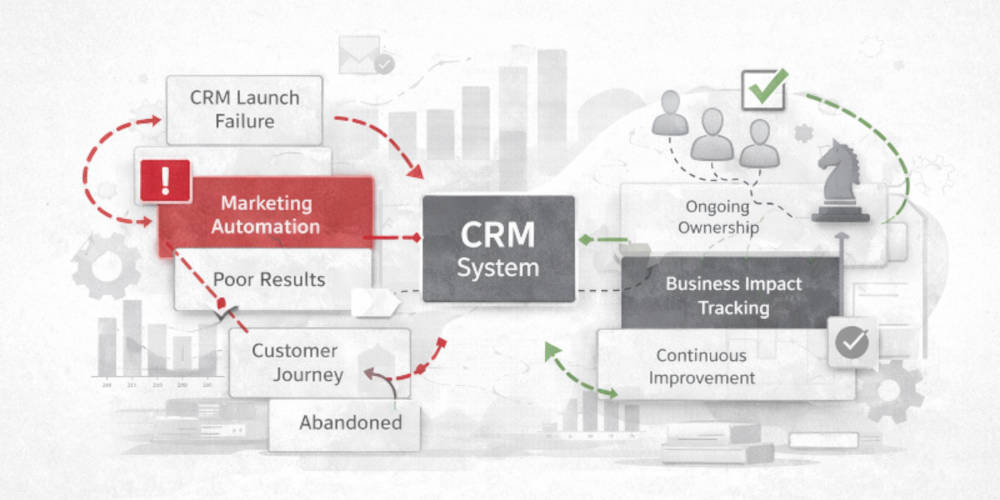
Why many CRM initiatives stall after launch
And what actually creates lasting impact
Many organisations invest significant time and resources in CRM journeys, yet still find that the CRM initiatives stall after launch. The problem rarely lies in the technology alone. It emerges when ownership, structure and further development are missing after the journeys have gone live.
Not because the technology does not work, but because the follow-up stops once the launch is over.
CRM initiatives rarely fail because of technology
In many CRM projects, the technical foundation is already in place. The tools work, the data base is sufficient, and the automation has been set up as intended. Even so, the journeys often lose impact over time.
Even so, this is often what we see:
What is often in place
- systems and tools are working
- the data base is sufficient to get started
- automation and integrations are set up
- the journeys are launched with clear goals
What often breaks down afterwards
- content and timing lose relevance over time
- the journeys are not further developed
- ownership and prioritisation become less clear
- CRM falls out of day-to-day operations
The problem is rarely technical. It appears when CRM is not followed up as part of the daily work after launch.
Launch is not the goal — it’s the starting point
A recurring pattern in many CRM projects is that the journeys are treated as a project with a clear end point. Once the automation is live and the journeys have been launched, attention quickly shifts to the next initiative.
The problem is that customer behaviour, needs and context do not stand still. What worked well at launch gradually loses impact if it is not followed up, adjusted and further developed as part of daily operations.
In practice, CRM journeys often:
are based on assumptions that no longer hold true
are not adapted to new customer types or changing usage patterns
lack clear signals for when something should be adjusted
It is rarely one major mistake that causes CRM journeys to die. More often, it is small things that are not followed up over time.
The three most common reasons CRM initiatives stall
When CRM initiatives lose impact over time, it is usually not because of one single mistake. More often, the problems point back to a few recurring causes.

Lack of ownership
When no one has clear responsibility for the journeys after launch, optimisation and follow-up quickly become something “someone should look into”.

Weak connection to actual business value
Opens and clicks are monitored, but without a clear link to churn, loyalty, customer value or development over time.

Overly complex structures
Journeys become so complex that the threshold for making changes becomes too high. It becomes easier to leave them as they are than to improve them.
When these three things appear at the same time, CRM gradually loses relevance, impact and its place in day-to-day operations.
CRM initiatives lose momentum when they are no longer tied to real work
When ownership is unclear, value is measured inconsistently, and the structure becomes too heavy, CRM gradually loses its place in day-to-day operations. The programs may still exist in the system, but they are no longer part of how the business actually works.
Lasting impact usually comes only when CRM is treated as part of ongoing prioritization, analysis, and follow-up. That is what makes the effect sustainable over time.
What characterizes CRM programs that actually last?
CRM programs that create stable results over time tend to share a few clear traits, regardless of industry, tools, or level of maturity.
Simple structures
that are easy to understand, adjust, and develop further
Clear ownership
both strategically and operationally, also after launch
Continuous improvement
based on real insight rather than assumptions
In practice, this means treating CRM as an ongoing discipline, not as a one-off project that ends at launch.
From automation to actual value
CRM and marketing automation are not about automating as much as possible. They are about automating the right things. Many programs lose effectiveness when the focus shifts from value to volume: more messages, more triggers, and more variations, without clear prioritization.
In practice, automation is often used to:
Misuse of automation
- increase the pace of communication without increasing relevance
- compensate for weak prioritization
- fill gaps where clear decisions are missing
At that point, CRM becomes a tool for efficiency, not a tool for value creation.
Real value only emerges when automation supports the work that already needs to be done:
Automation that supports value
- strengthen good decisions rather than replace them
- create clarity and structure rather than complexity
- free up time for work that requires human judgment
When automation is applied in the right place, it reduces friction instead of creating new dependencies. That is where the difference between CRM as a system and CRM as an actual way of working becomes clear.
From launch to lasting impact
CRM programs that last are rarely created by technology alone. They last because someone takes responsibility for following them up, adjusting them, and using them as part of everyday operations.
That is often where the real difference appears: between programs that remain in the system and programs that continue to create value over time. When CRM is treated as an ongoing practice, the effect becomes both clearer and more sustainable.
If you want to understand why CRM programs lose momentum in your organization, you can read more about the GTI Journey Diagnostic or go straight to the free assessment. You can also book a no-obligation conversation with us if you would like to discuss your situation before taking the next step, or explore more articles in our Insights section.



Test if your CRM programs are losing impact?
Start with a simple assessment of how ownership, structure, and follow-up work in practice.
If you want to understand where CRM is actually breaking down in your organization, it is often better to start with a clear picture than with more new initiatives. A structured assessment makes it easier to see what should be prioritized first.