
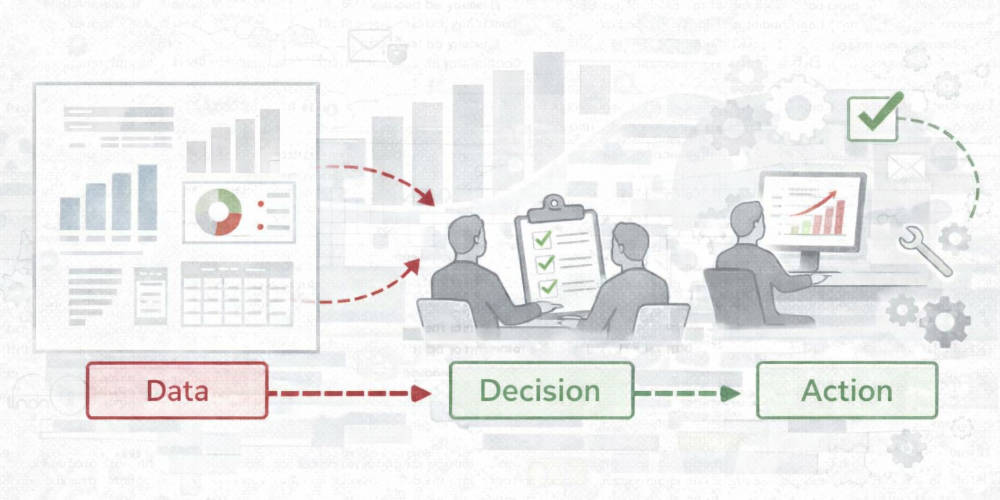
Data does not create value on its own. Decisions do.
Why so many organizations drown in dashboards and still lack direction.
Most organizations already have more than enough data available. Reports, dashboards, and analytics tools make it easier than ever to measure customer behavior, campaigns, and development over time. Even so, this does not automatically lead to better data-driven decision making or more lasting impact in practice.
Not because insight is missing, but because it is rarely used as an actual management tool.
Data rarely fails on volume
In most organizations, the problem is not a lack of data. Dashboards, KPIs, reports, and measurements already exist in large quantities. Even so, the impact often fails to materialize in practice.
What many organizations already have
- detailed dashboards
- many KPIs and measurement points
- frequent reports and status views
- good technical data quality
What is often still missing
- clear prioritization of what actually matters
- a link between measurement and concrete decisions
- ownership of follow-up and adjustment
- use of insight in day-to-day management
The challenge is rarely what is being measured. It lies in how the measurements are actually used.
When insight stops at reporting
A common pattern is that data is used to document what has happened, but much less to guide what should happen next.
Typical symptoms include:

Reports are shared, but do not drive action
insight becomes visible, but is not translated into clear priorities

KPIs are tracked, but not owned
targets are reported regularly, but without clear responsibility for what should be adjusted

Deviations are explained, but not followed up
differences and problems are identified, but rarely lead to actual change in practice
That is when insight remains as documentation of what has happened, rather than functioning as a starting point for what should happen next.
The difference between measurement and management
Many organizations are good at measuring, but far fewer use the numbers actively to manage the business. That is where the real difference appears.
Data
- what has happened
- status reporting
- an overview of development
Interpretation
- what the numbers mean
- what should be prioritized
- what requires attention
Management
- which decisions need to be made
- what needs to be adjusted
- how follow-up should continue
Organizations that succeed use data actively to make decisions, not just to explain the past.
Insight must be tied to ownership and routine
Data and insight only create value when they are part of a clear structure for follow-up. Without ownership and a regular rhythm, even strong analyses remain passive information, with little real effect on decisions and priorities.
In many organizations, the insight exists, but the anchoring does not. The numbers are available, but it is unclear who actually owns them and what is expected when they start moving in the wrong direction.
For insight to actually lead to action, three things need to be in place.
Clear ownership
Each KPI and each area of insight must have a defined owner, both strategically and operationally. When everyone follows the numbers but no one owns them, nothing changes.
A regular follow-up rhythm
Insight needs to be reviewed regularly, in fixed forums, with a clear purpose. Without rhythm, data loses momentum and becomes something people look at rather than something they manage by.
A link to data-driven decisions
The numbers must have a clear role in prioritization and decision-making. If insight does not influence what the business does more of, less of, or stops doing, it quickly becomes irrelevant.
When insight is clearly owned, followed up with rhythm, and used actively in decisions, data moves from reporting to becoming a real management tool.
Without ownership and cadence, insight remains information. With structure, it becomes management.
From dashboards to real data-driven decisions
Data, CRM, and analytics tools are powerful enablers, but they are still only tools. The real impact appears when insight is used to make concrete decisions in practice.
Prioritize
what actually needs attention right now
Adjust
what is not working well enough in practice
Optimize
what is already working, but can be improved
Stop
actions that no longer create value
When data is anchored in real decisions, it becomes a means of value creation, not just reporting.
When insight turns into better decisions
At its core, data-driven decision-making is about ownership and action. Not about more dashboards, but about clearer choices. Not about more insight, but about making better use of the insight the business already has.
If you want to understand where data and insight actually break down between reporting, prioritization, and action, you can read more about the GTI Journey Diagnostic before taking the next step. You can also book a no-obligation conversation with us if you would like to discuss your situation first, or explore more articles in our Insights section.
These are the types of challenges I most often work with at the intersection of CRM, customer journeys, and data-driven decision support. You’ll find more articles on the main page, Insights.

Ready for a first assessment?
See where insight and data break down between reporting, prioritization, and action.
The GTI Journey Diagnostic provides an initial indication of where gaps arise between observation, prioritization, and action. It makes it easier to see what should be improved first.