

Insight is not reporting – it is an operational capability
Why organisations need more than dashboards to use insight in practice
Many organisations have reports, dashboards and analyses, yet still lack a clear operational insight capability. The problem is rarely access to data alone. It is that insight is not reporting, is not interpreted, prioritised and translated into decisions and action.
Insight only creates value when the organisation is equipped to use it.
Why insight is often treated as an output, not a capability
In many organisations, insight is understood as something that appears when reports have been delivered, analyses are finished, or dashboards have been updated. Once the numbers have been processed and presented, it can feel as if the insight work is largely done. But insight is not reporting. The result is that insight is treated as an output of analysis, rather than as an operational capability the organisation needs to be equipped to use. That is exactly where the need for an operational insight capability becomes clear.
This is also why many organisations invest heavily in data sources, visualisation and reporting, but far less in the structures that make insight usable in practice. They may have good access to numbers and observations, but weaker capability when it comes to interpreting what matters most, deciding what should be prioritised, and translating that into clear action.
When insight is understood as something that is delivered and finished, it also becomes easier for it to remain at the side of the operational work. It is produced, presented and, at best, discussed, but not necessarily used as an active basis for prioritisation and governance. That is when a gap emerges between what the organisation knows and what it actually does something with.
That is exactly where the distinction becomes clear. Insight is not only a result of analysis. It is a capability that requires questions, interpretation, ownership and follow-up over time.
Insight creates little value when the organisation is not equipped to use it.
When insight is treated as a deliverable and when it functions as a capability
In many organisations, it is easy to see when insight work has been produced, but harder to see how it is actually used afterwards. This is also where the difference becomes clear between insight as something that is delivered and completed, and insight as a capability the organisation is equipped to use in practice.
When insight is treated as a deliverable
- reports and analyses are produced as finished outputs
- value is assessed based on the quality of the material
- the insight is presented, but only weakly used afterwards
- follow-up often becomes person-dependent
- observations are highlighted without clear prioritisation
- the connection to decisions and action is unclear
When insight functions as a capability
- insight is used actively in prioritisation and governance
- value is assessed based on the quality of the decisions it supports
- interpretation and follow-up are part of the work
- responsibility and ownership are more clearly defined
- signals are assessed against goals and direction
- insight influences choices, actions and follow-up
The difference is not only about how good the analyses are, but about how the organisation works with them afterwards. When insight functions as a capability, it does not stop at presentation. It becomes part of how the business evaluates development, prioritises attention and follows up what actually matters. This means insight is not reporting or treated as such.
Insight creates value when it influences what the organisation does
Reports, analyses and dashboards can make observations visible. Insight only becomes operational when it is used to assess development, prioritise attention and support concrete choices going forward.
Insight is not something an organisation simply produces. It is something it must be equipped to use.
That is why the difference between visibility and actual governance matters so much. The value does not lie only in the fact that something has been analysed, but in whether the organisation is able to use it as a basis for action.
How operational insight capability is built in practice
For insight to create value in practice, the organisation must do more than collect, analyse and present data. It also needs a way to work further with the signals that emerge. Insight only begins to gain operational meaning when it is interpreted, prioritised and followed up.

Interpretation
Signals must be understood in context, not only recorded. Numbers and observations only gain value when they are seen in relation to goals, customer behaviour, market conditions and priorities.

Prioritisation
What matters most must be separated out and brought forward. Not every observation requires the same level of focus, and without clear prioritisation, insight easily remains interesting rather than governing.

Follow-up
Insight must influence choices, actions and further governance. Only when it is used in decisions and concrete follow-up does it become part of how the organisation actually works.
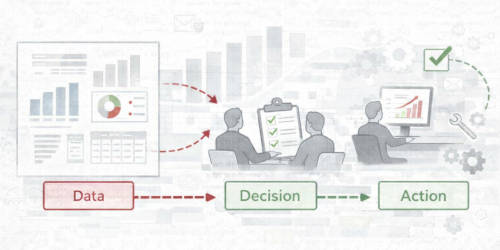
Without operational insight capability, insight easily remains analysis, not governance. Insight only becomes operational when it moves from observation to prioritisation and then into action.
What characterises organisations that actually use insight operationally
Organisations that create more value from their insight work rarely stand out because they have the most data or the most advanced dashboards. More often, the difference lies in how they work further with what they see. They do not use insight as a parallel track alongside operations, but as part of how development is assessed, prioritised and followed up.
That also means they are clearer about which questions insight is meant to help answer. They tend to have stronger ownership of interpretation and prioritisation, and greater discipline in how observations are translated into choices and further action.
In practice, the difference often comes down to four clear characteristics:
Insight is connected to concrete questions and goals
Interpretation and prioritisation have clearer ownership
Observations are used to support choices, not only reporting
Follow-up is part of the work, not something that happens randomly afterwards
When these elements are in place, insight becomes something the organisation actually works with, not just something it produces and presents. That is often where the difference appears between organisations that see a great deal and organisations that actually use what they see to govern better.
Insight only creates value when it is used
Reports, analyses and dashboards can be important tools in insight work. But they do not create operational value on their own. Only when the organisation has the capability to interpret signals, prioritise what matters most and follow it up in practice does insight begin to have real meaning. That often requires the development of an operational insight capability.
That is why the question is not only whether the organisation has access to good data or clear analyses. The decisive factor is whether it is actually equipped to use insight to support choices, improvements and further governance.
When an organisation has extensive reporting and analysis, but still lacks clear direction on what should be prioritised and followed up, the problem is often not access to insight alone. It has more to do with how the insight is actually used in practice. In such situations, it can be useful to start with an initial assessment of where the customer journey creates friction, where the weakest links are, and where further follow-up should begin.
Read more about GTI Journey Diagnostic and how the service can be used as a practical first step, or start directly with a free assessment. You are also welcome to book a no-obligation conversation with us if you would like to discuss the situation before moving forward, or explore more articles in our Insights section.

Ready for a first assessment?
See how well your customer journeys actually work together in practice
Many companies have activities, systems and initiatives in place, but still lack a clear view of how their customer journeys work as a whole. Journey Diagnostic gives you a free first assessment of current status and possible gaps.