
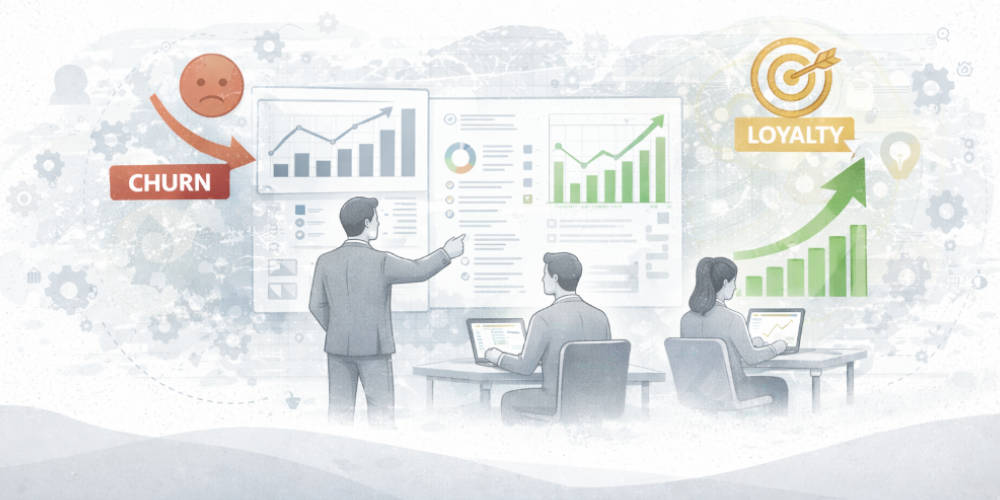
Profitable growth and customer loyalty is not about running more campaigns
Value is created when growth, churn, and loyalty are managed as one connected system.
Many companies try to create profitable growth and customer loyalty by increasing pressure: more campaigns, more channels, and more activity. Even so, the effect often levels off. New customers come in, but they do not stay long enough. Existing customers remain, but without creating more value over time.
The problem is rarely a lack of effort. It arises when growth, churn, and loyalty are treated as separate issues instead of as parts of the same customer logic.
Not because the company is doing too little, but because the efforts are not connected well enough.
Growth rarely fails because of ambition
Most companies are not short on growth ambitions. The goals are clear, activity levels are high, and the tools are already in place. Even so, growth often starts to flatten out.
What many companies already have in place
- clear sales and growth targets
- high activity across campaigns and channels
- CRM, analytics, and automation in use
- a strong focus on new customer acquisition and conversion
What is often still missing
- an understanding of what actually drives churn
- a focus on value after the first purchase
- a clear connection between loyalty and growth
- follow-up on what existing customers actually become over time
Growth often does not slow down because the market disappears. It slows when new customer acquisition moves faster than the company’s ability to create value over time. That is when growth becomes expensive, unstable, and difficult to scale.
When churn is treated as a symptom rather than a problem
Churn is often measured, reported, and explained. Much less often is it used actively as a management signal.
In many organizations, it looks like this:
churn is analyzed after the fact
customer loss is explained by price, market conditions, or competition
action is taken too late, often only when the customer is already on the way out
responsibility is unclear across marketing, product, and customer service
That is when churn becomes something the business explains, rather than something it actually manages. In reality, churn is rarely the result of a single event. More often, it reflects declining relevance, poor timing, or unclear expectations over time.
Loyalty is not created by points, but by perceived value
Many loyalty initiatives begin with rewards. Far fewer begin with the customer’s actual needs. Points, discounts, and benefits can reinforce value, but they rarely create loyalty on their own. Real loyalty emerges when the customer experiences consistency, relevance, and value over time.
In practice, loyalty is built when:
Customer value over time
the customer experiences value throughout the relationship, not only at the point of purchase
Relevance in communication and offers
communication is relevant and adapted to the situation, not the same for everyone
Development in line with customer needs
the solution evolves with the customer’s needs, not only with internal plans
A sense of being understood
the relationship feels understood, not mechanical or over-automated
Loyalty is less about incentives and more about consistency. When loyalty is reduced to a campaign tactic or a bonus program, what often gets lost is the most important part: understanding why the customer actually chooses to stay.
Growth, churn and loyalty are always connected
Profitable growth happens when growth, churn, and loyalty are managed as parts of the same system.

Growth
is about bringing in the right customers in a way that remains sustainable over time

Churn
is about understanding what weakens value, relevance, and continued development in the customer relationship

Loyalty
is about strengthening value, relevance, and continued development in the customer relationship
When these are treated in isolation, the bigger picture is lost. When they are connected, it becomes possible to manage both customer value and profitable growth.
From campaign logic to lifecycle thinking
Campaign logic is often about creating activity here and now: sendouts, offers, and increased pressure in the market. Results are measured quickly, and the focus is on immediate conversion.
Lifecycle thinking starts from a different place. The customer journey is seen as a connected process, where each interaction builds on the one before it. The goal is not just response, but progression, from first contact to lasting value.
When that perspective changes, what the business actually prioritizes changes as well.
they prioritize customer lifecycle over individual campaigns
they use customer data to adjust along the way
they measure impact over time, not just response and conversion
they treat churn as an early signal, not an endpoint
Growth then becomes the result of improvement, not increased volume.
What actually creates impact in practice
In work related to growth, churn, and loyalty, the strongest results often come when a few things are made to work well in practice:
Clear and relevant onboarding
Expectations are set early, and the customer quickly understands how the solution actually creates value.
Content that supports the customer journey
Communication is adapted to where the customer is in the relationship, rather than being sent out in the same way to everyone.
Friction is identified before churn
Signals of uncertainty or low usage are detected and addressed before the customer is actually on the way out.
Actions guided by real impact
Decisions are based on insight and value over time, not gut feeling or campaign pressure.
Small, continuous adjustments often create more impact than large campaigns.
From short-term growth to long-term value
Growth that does not take churn and loyalty into account is often short-lived. It may look strong for a while, but it becomes fragile when new customers constantly have to replace those who leave.
Long-term value is built differently. It emerges when a business understands customer behavior over time, prioritizes the right actions, and manages growth, churn, and loyalty as parts of the same system. That makes development more stable, more profitable, and easier to predict.
The difference between short-term growth and long-term value is rarely about speed. It is about direction.
Create profitable growth and customer loyalty
Profitable growth and customer loyalty are rarely created by running more campaigns alone. They emerge when a business sees growth, churn, and loyalty in context, and manages them as parts of the same system.
When insight is used to prioritize the right actions over time, development becomes more stable, more profitable, and easier to influence. Not necessarily because the pace increases, but because the direction becomes clearer.
That is often where the real difference lies: between activity that creates pressure here and now, and work that actually builds value over time.
If you want an initial indication of what this looks like in your own business, you can read more about the GTI Journey Diagnostic or go straight to the free assessment. You can also book a no-obligation conversation with us if you would like to discuss your situation before taking the next step, or explore more articles in our Insights section.



Want to see where growth, churn, and loyalty are actually breaking down in your business?
Start with a simple assessment of how customer value, churn, and loyalty work together in practice.
If you want to understand where the friction actually lies in your business, it is often more useful to start with a clear picture than with more new initiatives. A structured assessment can make it easier to see what should be prioritized first.