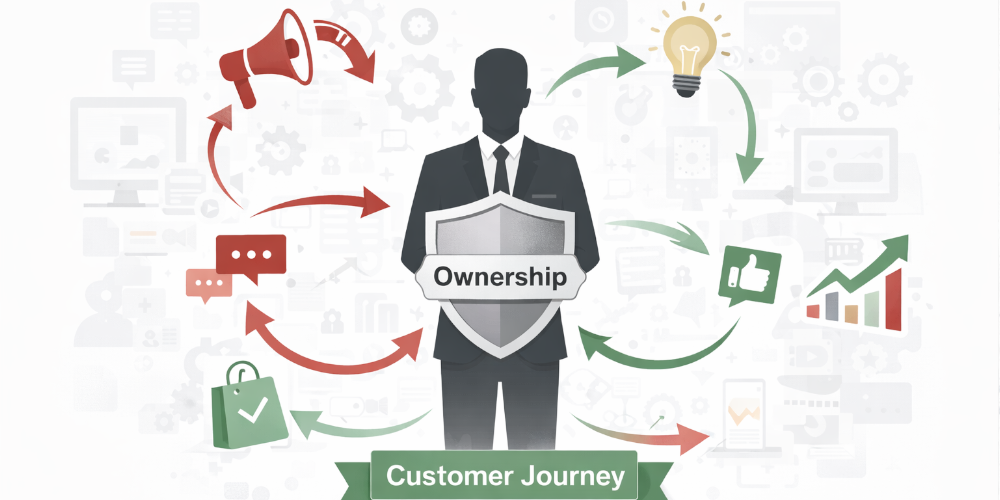
Who really owns the customer journey in your organization?
The question sounds simple. The consequences are commercial.
Marketing owns campaigns. Product owns features. Sales owns conversion. Customer service owns inquiries and problems. But who really owns the customer journey in your organization?
In many organizations, the customer journey is defined, mapped and presented. It lives in PowerPoint. It lives in the CRM system. It lives in dashboards.
What is often missing is clear ownership.
When responsibility is divided, the experience becomes divided
The customer journey crosses functions
Modern organizations are specialized. That is natural. Expertise becomes stronger, tools more advanced and responsibilities more clearly defined.
The challenge arises when the customer journey crosses the boundaries between them.
Onboarding
Influenced by product
Activation
Influenced by marketing
Perceived value
Influenced by both delivery and communication
Loyalty
Influenced by the entire experience over time
When no one owns the whole journey
When no one has the mandate to prioritize the lifecycle across these functions, what often emerges are “silos”. But the consequence is not only organizational. It is commercial.
Different KPIs pull in different directions
Initiatives are optimized locally
Campaigns are executed without holistic prioritization
The result is not necessarily poor work, but fragmented impact. Structure beats intention. Without a structure for holistic governance, even good initiatives become isolated.
From project to vacuum
This becomes especially clear when the customer journey is treated as a project with a start and an end – rather than as an operating model.
Many organizations start correctly:
Project logic
- Map the customer journey
- Identify friction
- Implement CRM and automation
- Build dashboards
Operating model
- Prioritize continuously
- Adjust based on impact
- Own customer value over time
- Have the mandate to stop initiatives
And then the project ends.
The systems are in place
Everything works technically.
The customer journey is documented
It exist in PowerPoint and dashboards.
The automations are running
The flow goes as planned.
But who prioritizes the next improvement? Who has the mandate to say:
This initiative does not create value. We stop it.
This area matters more than the next campaign.
This impacts churn more than traffic.
When the project ends without an operating model being defined, a vacuum appears. The customer journey exists – but it is not governed.
What does it actually mean to own the customer journey?
Owning the customer journey is not about mapping it. Real ownership consists of four elements:
Responsibility for customer value over time
Ownership must be tied to impact – not delivery.
Mandate across functions
Priorities must be decided where customer value is affected.
Clear connection between data and decisions
Numbers should guide choices – not just be reported.
The ability to stop initiatives
Initiatives that do not create value must be discontinued.
The customer journey then becomes more than a description of how customers move. It becomes a governance model for how the organization prioritizes.
Without ownership, CRM is a tool.
With ownership, CRM becomes a way of working.
Three signs that no one truly owns the customer journey
It is often easy to recognize when ownership is missing.

KPIs pull in different directions
Marketing optimizes for response. Product optimizes for usage. Sales optimizes for volume. No one optimizes for overall customer value.

Initiatives stop after launch
Significant effort is invested in implementation and setup. Then attention shifts. Follow-up becomes sporadic, and continuous development lacks structure.

No one can clearly explain what drives customer value over time
There is data. There are reports. But there is no shared understanding of which actions truly impact churn, lifetime value or margin.
These signals do not necessarily point to weak teams. They point to a lack of structure for holistic governance.
The customer journey as an operating model – not a campaign plan
Mature organizations do not treat the customer journey as a project or a campaign plan. They use it as an operating model.
This means
Clear ownership and accountability
Defined prioritization mechanisms
Value-based KPIs
A structure for continuous learning
In such a model, the customer journey is not just a description of the customer experience. It is the framework for how the organization makes decisions.
Who prioritizes onboarding over the next campaign?
Who decides that loyalty matters more than traffic?
Who reallocates resources when the data indicates it?
When these questions have clear answers, the customer journey begins to function as a governance tool.
Without ownership, the customer journey becomes an intention
Most organizations want to deliver strong customer experiences. Intention is rarely the problem. Accountability is.
When ownership is unclear, the customer journey is treated as a project. When ownership is clear, it becomes a structure.
The difference does not lie in how many initiatives are launched, but in who has the mandate to govern the whole over time.
The customer journey is not a campaign.
It is not a PowerPoint.
It is not a system.
It is an operating model for how the organization creates customer value.
Conclusion
Owning the customer journey is not about completing a map. It is about giving it direction.
Structure, governance and a clear mandate are what separate fragmented initiatives from sustainable impact. When responsibility is unclear, parts are optimized. When ownership is clear, customer value is optimized over time.
For organizations that want to turn the customer journey into an operating model, the work starts with one question:
Who governs the whole?
Impact is created at the intersection of CRM, organizational design and data-driven prioritization.
Success with customer journeys is therefore not about more initiatives, but about clearer accountability.
If you want to make your customer journey more operational in your organization, I am happy to discuss how this applies to your organization. You can also explore more perspectives on the topic in the Insight section.
Ready to get started?
Let’s clarify your goals, needs and opportunities – completely without obligation.
Whether you have a concrete challenge or simply want a second opinion, we start with a simple and structured conversation. The goal is to understand how we can create real value together.