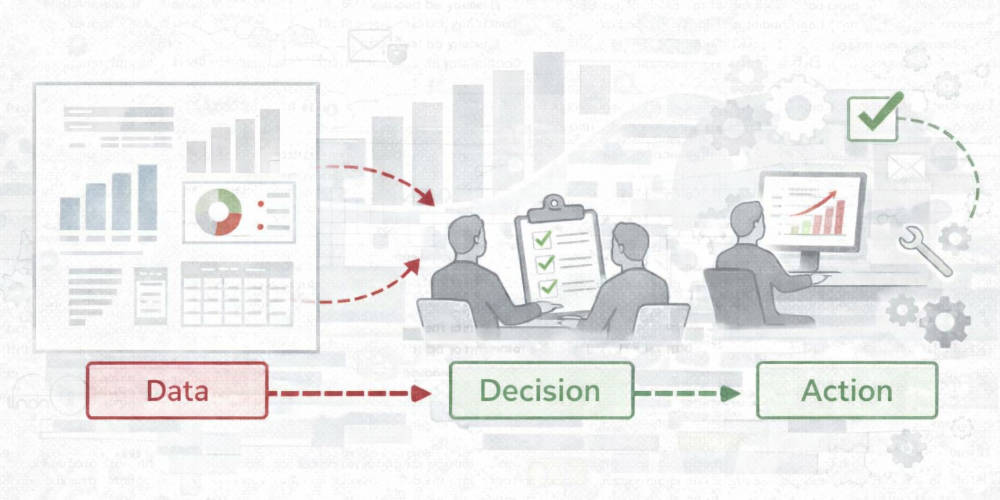
Data doesn’t create value — decisions do
Why many organizations drown in dashboards, but still lack direction
Data-driven decision making is rarely limited by a lack of data. In most organizations, the real challenge is not what is measured, but how insight is used to guide priorities, decisions, and everyday execution. Most organizations today have more data than ever. CRM systems, analytics tools, reports and dashboards provide constant insight into customers, campaigns and behavior.
Yet many experience that this insight rarely leads to better decisions or lasting impact — not because data is missing, but because it’s rarely used as a true management tool.
Data rarely fails on volume
In most organizations, lack of data is not the problem. On the contrary, it is common to have:
Detailed dashboards
Visualize large amounts of data and provide overview, but often used more for reporting than for ongoing prioritization and decision-making.
Too many KPIs
Measure a lot, but often dilute focus. When everything is important, it becomes unclear what should actually drive decisions.
Frequent reports
Provide regular status updates, but without clear ownership or follow-up, they rarely lead to real change.
Good technical data quality
Data is accurate and accessible, but technical quality alone does not lead to better decisions.
Even so, impact often fails to materialize. The data exists, but rarely influences priorities, workflows, or decisions in daily operations.
The challenge is rarely what is measured — but how the measurements are actually used.
When insight stops at reporting
A recurring pattern is that data is treated as documentation — not as a management tool.
Typical symptoms include:

Reports
Reports are shared, but rarely discussed or actively used.

KPIs
KPIs are tracked, but ownership is unclear.

Deviations
Deviations are explained, but rarely lead to action.
Insight becomes a definitive answer to what happened — rather than a starting point for deciding what to do next.
The difference between measurement and management
Many organizations are good at measuring performance, but far fewer use data actively for management. This is where the real difference lies.
Measurement focuses on:
- History
- Reporting
- Status
Management focuses on:
- Priorities
- Decisions
- Adjustment over time
Organizations that succeed use data-driven decision making — not just to explain the past.
Insight must be tied to ownership and routine
Data and insight only create value when they are part of a clear structure for follow-up. Without ownership and regular routine, even strong analyses remain passive information — with no real impact on decisions or priorities.
In many organizations, insight exists but lacks anchoring. The numbers are available, but it is unclear who actually owns them, and what is expected when they move in the wrong direction.
For insight to lead to action, three fundamental conditions must be in place.
Clear ownership
Every KPI and insight area must have a defined owner — both functionally and operationally. When everyone follows the numbers, but no one owns them, change rarely happens.
A regular interval for follow-up
Insight must be reviewed regularly, in fixed forums, with a clear purpose. Without cadence, data loses momentum and becomes something you look at — not something you manage by.
Direct connection to decisions
Numbers must play a clear role in prioritization and decision-making. If insight does not influence what you do more of, less of — or stop doing — it quickly becomes irrelevant.
When insight is clearly owned, followed up with cadence, and actively used in decision-making, data moves from reporting to becoming a true management tool.
Without ownership and cadence, insight remains information. With structure, it becomes management.
From dashboards to real impact
Data, CRM, and analytics tools are powerful enablers — but they are still just tools. Real impact only happens when insight is actively used to:
Prioritized actions
Insight helps determine what should be done now — and what can wait. Data enables clearer prioritization by directing effort toward where impact is greatest.
Adjusted customer journeys
Customer journeys are continuously improved based on actual behavior, not assumptions. Small adjustments in flow, timing, or friction often create more impact than large redesigns.
Changes to content, timing, or channel mix
Insight is actively used to optimize messaging, timing, and channel selection. What works is reinforced, and what doesn’t is quickly adjusted.
Removing what doesn’t work
Data makes it easier to stop initiatives that fail to deliver results. Removing unnecessary activities frees up capacity for what actually creates value.
When data is anchored in real decisions, it becomes a driver of value creation — not just efficient reporting.
Conclusion
Effective use of data-driven decision making ultimately comes down to accountability and action. Not more dashboards, but clearer choices. Not more insight, but better use of the insight you already have.
These are the types of challenges I most often work with at the intersection of CRM, customer journeys, and data-driven decision support. You’ll find more articles on the main page, Insights.
Ready to get started?
Let’s clarify goals, needs and opportunities — with no obligation.
Whether you have a concrete challenge or simply want a second opinion, we start with a simple and structured conversation. The goal is to clarify if — and how — we can create value together.