
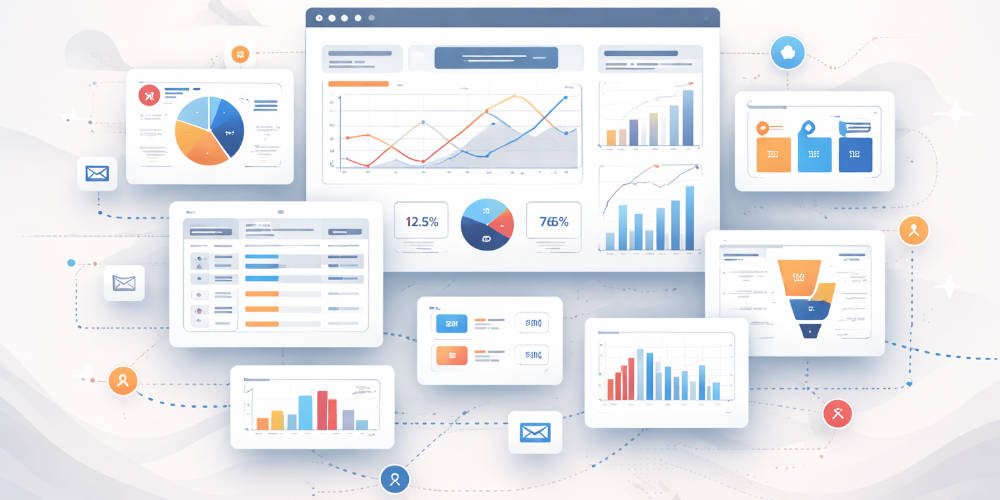
Why dashboards do not create insight
When data is clearly visible, but still does not give the business direction on what to do next
Dashboards can make data more accessible, but they do not automatically create insight. Value only appears when numbers, observations and patterns are used to understand what something means and what should happen next.
A dashboard shows what is happening. Insight explains what it means.
Why dashboards are often seen as useful
Dashboards serve a clear purpose in many organisations. They bring numbers together, make change visible, and give leaders and teams a shared surface for follow-up. When data is presented clearly and kept up to date, it creates a sense of control. It becomes easier to monitor progress, easier to report, and easier to see that something is moving.
That is also why dashboards are so often taken as proof that the organisation is working in a data-driven way. The numbers are available. The charts look professional. Development can be followed from week to week or month to month. On the surface, it looks as if the organisation has gained a stronger basis for decision-making.
The problem is that available information is not the same as insight. A dashboard can show that conversion is falling, churn is increasing, or traffic is developing differently than expected. But it does not necessarily explain why it is happening, what matters most, or what the business should do next.
That is why a gap often emerges between what the organisation can see and what it actually understands. Dashboards make data visible. Insight still requires interpretation, prioritisation and action.
Dashboards create visibility. Insight creates direction.
Why dashboards still do not create better decisions
Many dashboards look well developed and create a clear sense of control. Even so, there is often a significant gap between being able to see numbers and being able to use them to make better decisions. The problem rarely lies in the visualisation alone, but in what the dashboard is actually connected to in the organisation. That is exactly why many organisations discover that dashboards do not create insight, even when the numbers are easy to access.
They lack context
Numbers can show that something is happening, but not why it matters. Without context and interpretation, the dashboard supports visibility, not decisions.
They create too much noise
When many metrics are shown at once, it becomes harder to see what really matters most. The result is more monitoring, but not better prioritisation.
They are weakly tied to decisions
A dashboard can show status, but not decide what the business should do next. Without translation into choices and action, the value stops at visibility.
They lack clear ownership
Dashboards are often shared widely, but weakly owned. When no one interprets the signals and follows up the consequences, they are seen, but not used to steer.
A dashboard can support decisions. It cannot replace them.
A dashboard shows what is happening. Insight explains what it means
A dashboard can show development in sales, churn, traffic or user behaviour. It can make status visible and give the organisation a shared overview. But data only starts to become insight when someone interprets the patterns, places them in context and assesses what consequences they should have.
This is a distinction many organisations underestimate. They invest in data foundations, reporting and visualisation, but place less weight on the part of the work that is about understanding what the numbers actually mean. As a result, the dashboard starts to stand as an answer in itself, even though it is often only the beginning of the analysis.
Insight is not only about knowing that something is happening. It is about understanding why it is happening, what matters most right now, and which choices the business should make next. Without that, even good dashboards remain mostly a tool for visibility, not for direction.
That is why the difference between reporting and insight matters so much. Reporting makes development visible. Insight makes it usable.
What organisations often lack between dashboard and action
Many organisations do not have a problem collecting data or making numbers visible. The problem arises in what happens afterwards. Between the dashboard and the actual decision, there are several links that are often weakly defined, poorly owned or entirely missing.
This is where the value usually stops. The numbers exist. Reporting is in place. But the organisation lacks a clear path from observation to interpretation, from interpretation to prioritisation, and from prioritisation to action.
That is also why dashboards often carry more strategic weight than they really deserve. When the visualisation is strong, it can look as if the organisation is in control. In practice, it may still be missing the most important thing: a structure for understanding what something means, who should respond, and what should happen next. Because dashboards do not create insight on their own.
Data
Numbers, signals and observations are collected from different sources across.
Reporting
The information is structured and presented in dashboards, reports or similar formats.
Interpretation
The development must be understood, placed in context and assessed.
Prioritisation
The business must decide what matters most and what should be prioritised.
Decision
Observations must be translated into concrete choices, direction and clear responsibility.
Action
Actions must be initiated, followed up and evaluated over time.
It is rarely the dashboard that is missing. It is the links between numbers and action that fail.
When dashboards become a substitute for analysis
In many organisations, the dashboard is treated as if it were the answer in itself. When the numbers are visible, the situation feels understood. When development can be followed in charts and tables, it looks as if the organisation has a solid basis for decision-making. In practice, however, the dashboard is often only the first step.
The problem arises when the visualisation starts to replace the analysis that should follow. Reporting then remains a finished output, instead of functioning as a starting point for questions, interpretation and prioritisation. The numbers are shown, but no one goes further into what is driving the development, which patterns matter most, or what the business should actually respond to.
The problem is rarely that the organisation sees too little. It is that it understands too little of what it sees.
This is also where many dashboards take on more strategic weight than they can carry on their own. They look well developed, they are updated regularly, and they give leaders and teams something concrete to gather around. But without a clear analytical capability around them, they often become more useful for follow-up than for direction.
That is why the main challenge is rarely that organisations lack dashboards. The challenge is that they often lack the structure that makes dashboards operational: someone who interprets the signals, places them in business context and translates them into choices and action.
A good dashboard is a starting point for analysis, not a substitute for it.
What must be in place for data to become insight
The fact that numbers are available does not mean they automatically become useful. For data to develop from reporting into actual insight, the business needs more than dashboards and updated overviews. It also needs a structure for how information is understood, prioritised and used.
It starts with the questions the organisation is trying to answer. When dashboards are built without clear problem definitions, they often become broad overviews with a lot of information but little direction. Insight is more likely to emerge when data is read in light of concrete questions, goals and decisions.
Clear questions
Data becomes more valuable when it is used to answer clear questions and support decisions.
Context and meaning
Numbers only create value when they are read in context with goals, behaviour and business needs.
Clear ownership
Someone must be responsible for interpreting the development and following up what matters most.
Connection to action
Insight creates value when it influences choices, priorities and concrete next steps.
It is also about context. Numbers only gain value when they are seen in connection with customer behaviour, the business model, market conditions and operational priorities. Without that, even precise reporting easily remains a set of disconnected observations.
Ownership is just as important. Someone must be responsible for interpreting the development, asking the right questions and highlighting what actually requires follow-up. When that responsibility is unclear, dashboards tend to be used for monitoring, but not for steering.
Finally, insight must be connected to decisions and action. If observations are not translated into choices, priorities and concrete measures, the value stops at the analysis stage. The dashboard then becomes a tool for visibility, but not for progress.
Insight does not emerge when data is shown. It emerges when data is understood and used.
That is why many organisations need more than reporting
Many organisations already have dashboards, KPIs and access to large amounts of data. Even so, it is often still unclear where friction in the customer journey actually occurs, which signals matter most, and why decisions still do not become clearer.
When data is visible but the direction remains unclear, the problem rarely lies in reporting alone. More often, it is about how insight is interpreted, prioritised and used in practice.
It is not always more data that is missing. More often, it is the structure that makes the data useful.
Dashboards are useful. Insight requires more.
Dashboards can be valuable tools for visibility, follow-up and reporting, but dashboards do not create insight on their own. The problem starts when they are given a role they cannot fulfil by themselves. They can show development, but they cannot replace interpretation, prioritisation and decision-making.
That is why the question is not only whether the organisation has enough data. The decisive factor is whether it has the structure that makes the data understandable and usable in practice. When that structure is missing, even good dashboards often remain clear overviews of problems that still do not get solved.
When the organisation can see a great deal but still lacks direction on what should be followed up first, it can be useful to start with an initial assessment of the current situation. That makes it easier to see where the signals are pointing, where the weak points lie, and where further follow-up should begin.
If you want an initial indication of what this looks like in your own organisation, you can read more about GTI Journey Diagnostic or start directly with a free assessment. You are also welcome to book a no-obligation conversation with us if you would like to discuss why dashboards do not create insight for your organisation before moving forward, or explore more articles in our Insights section.



Ready for a first assessment?
See how well your customer journeys actually work together in practice
Many companies have activities, systems and initiatives in place, but still lack a clear view of how their customer journeys work as a whole. Journey Diagnostic gives you a free first assessment of current status and possible gaps.